Electrical Engineering

Electrical Engineering

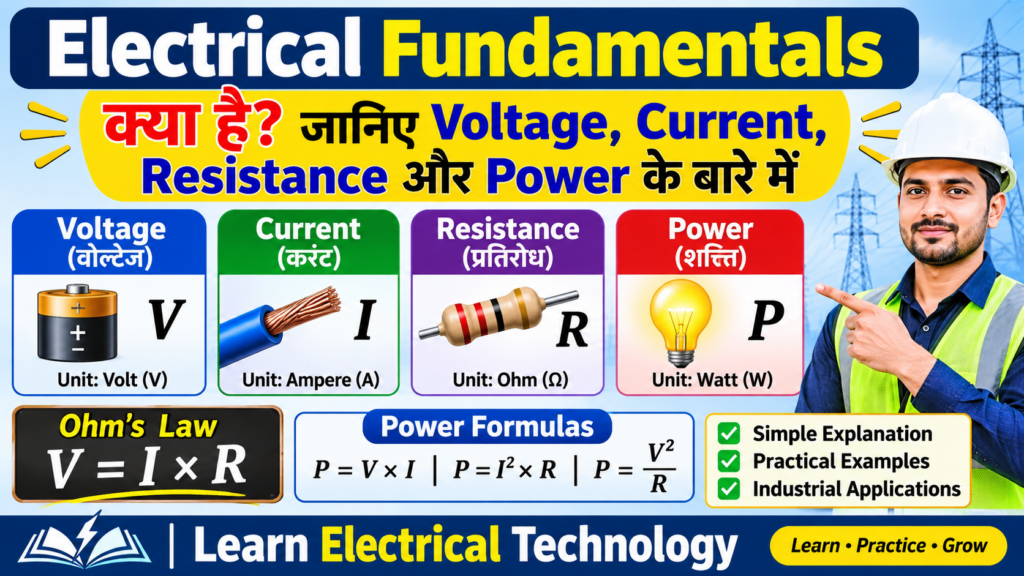
Electrical Fundamentals क्या है? जानिए Voltage, Current, Resistance और Power के बारे में

Electrical Engineering सीखने के लिए Electrical Fundamentals को समझना बहुत जरूरी है। चाहे आप Electrical Engineer हों, Technician हों या Electrical Engineering के Student, आपको Voltage, Current, Resistance और Power की जानकारी होनी चाहिए।इस पोस्ट में हम Electrical Fundamentals के चार मुख्य Concepts को आसान हिंदी और Practical Examples के साथ समझेंगे।Type your paragraph here 1. Electrical Fundamentals क्या है? Electrical Fundamentals का अर्थ है बिजली से जुड़े Basic Principles और Concepts को समझना।इसके अंतर्गत Voltage, Current, Resistance, Power, AC Supply, DC Supply और Electrical Circuits जैसे महत्वपूर्ण विषय आते हैं।ये Concepts Electrical Panel, Motor, Transformer, PLC, VFD और Industrial Automation Systems को समझने का आधार हैं। 2. Voltage (वोल्टेज) क्या है? Voltage किसी Electrical Circuit में Current Flow करने के लिए आवश्यक Potential Difference है।Symbol: VUnit: Volt (V)Measuring Instrument: Voltmeter Practical Examples:Domestic Supply: 230V ACIndustrial Supply: 415V ACPLC Control Supply: 24V DC 3. Current (करंट) क्या है? Electric Current किसी Conductor में Electric Charge के Flow को कहते हैं।Symbol: IUnit: Ampere (A)Measuring Instrument: AmmeterElectrical Panel में Ammeter की सहायता से Current मापा जाता है।उदाहरण: यदि किसी Motor का
Electrical Engineering

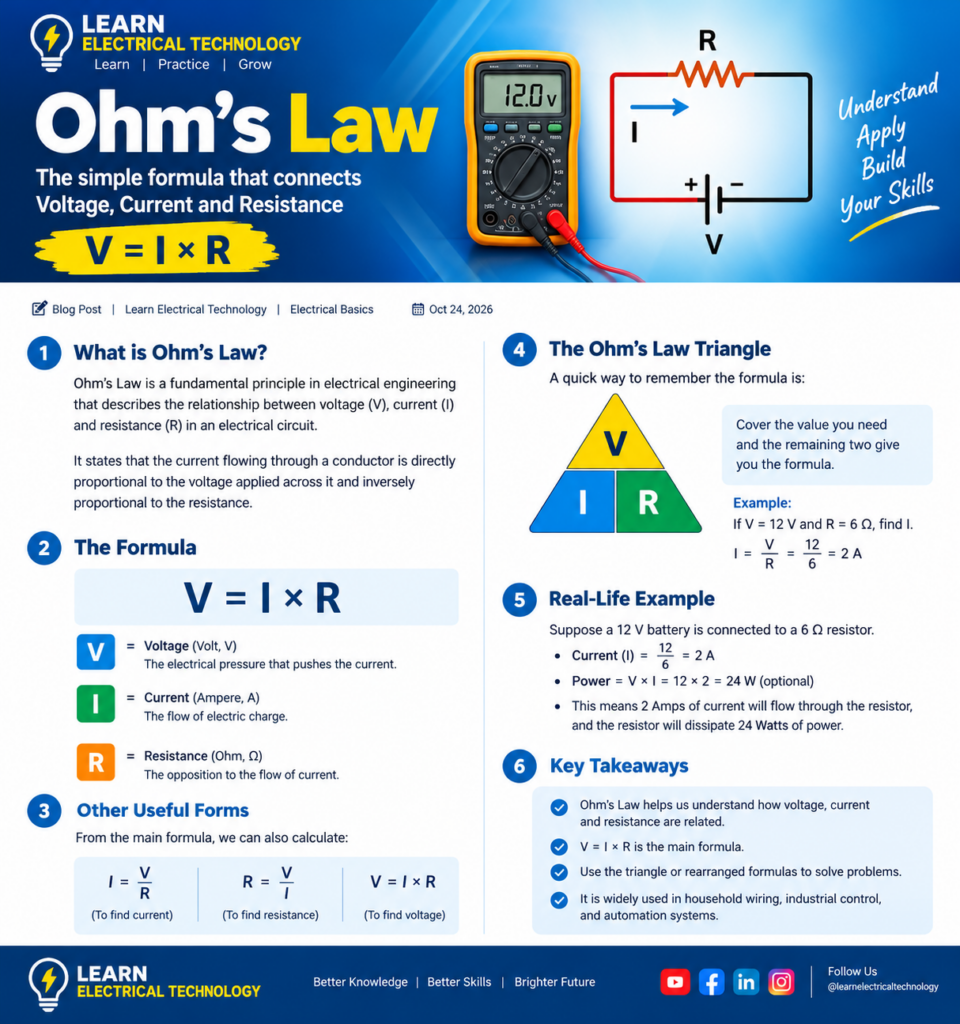
Ohm’s Law: Formula, Definition, Triangle & Practical Examples

Introduction Ohm’s Law is one of the most important fundamental laws in electrical engineering. It explains the relationship between voltage, current, and resistance in an electrical circuit.Understanding Ohm’s Law helps electrical engineering students, electricians, PLC programmers, and automation engineers calculate circuit values and troubleshoot electrical systems. 1. What Is Ohm’s Law? Ohm’s Law states that the current flowing through a conductor is directly proportional to the voltage applied across it and inversely proportional to its resistance, provided the physical conditions, especially temperature, remain constant. 2. Ohm’s Law Formula The main formula is:V = I × R Where:V = Voltage, measured in volts (V) I = Current, measured in amperes (A) R = Resistance, measured in ohms (Ω)Three important formulas To calculate voltage: V = I × R To calculate current: I = V ÷ R To calculate resistance: R = V ÷ 3. Ohm’s Law Triangle The Ohm’s Law triangle is a simple memory tool. Place V at the top and I and R at the bottom. Cover the quantity you want to calculate:Cover V: multiply I by R.Cover I: divide V by R.Cover R: divide V by I.4. Practical Examples of Ohm’s LawExample 1: Calculate currentGiven:Voltage = 12 VResistance = 6 ΩFormula: I = V ÷ RCalculation: I = 12 ÷ 6 = 2 AAnswer: The current is 2 amperes.Example 2: Calculate voltageGiven:Current = 3 AResistance = 4 ΩCalculation: V = I × R = 3 × 4 = 12 VAnswer: The voltage is 12 volts.Example 3: Calculate resistanceGiven:Voltage = 24 VCurrent = 2 ACalculation: R = V ÷ I = 24 ÷ 2 = 12 ΩAnswer: The resistance is 12 ohms.

Scroll to Top